Guide
What Is a Ball Vape? Ruby Spheres, Big Clouds, Explained
26 August 2026 • 10 min read (Updated 9 September 2026)
A ball vape pulls air through a bed of hot ruby or zirconia spheres to vaporize herb in a draw or two. How it works, the four styles, temps, and who should skip one.
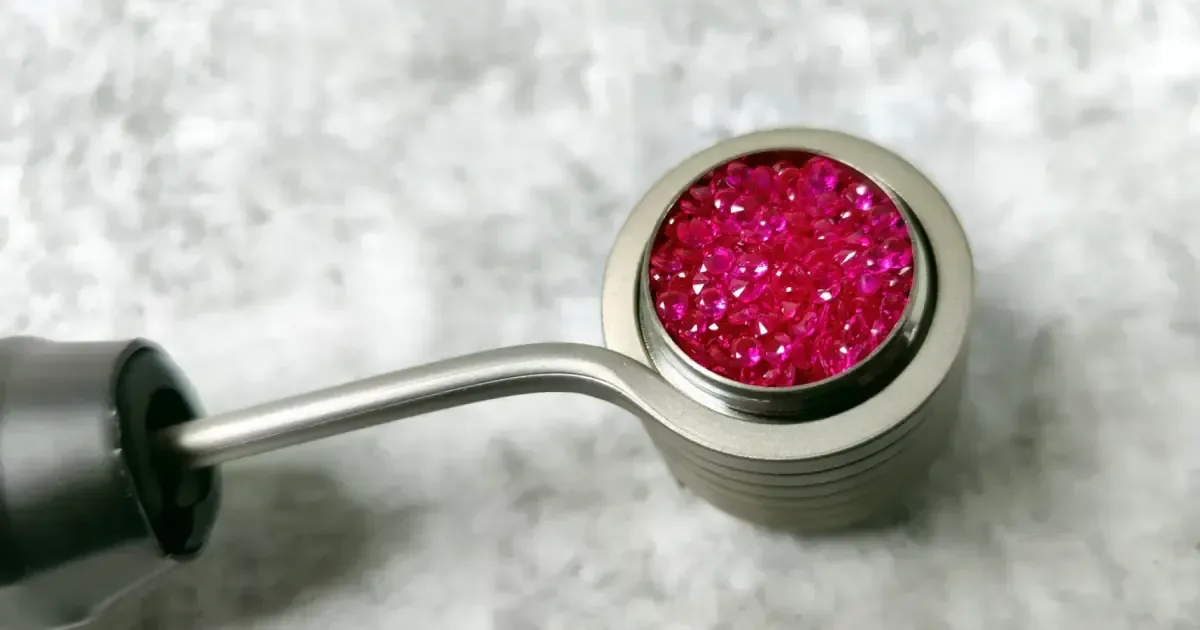
A ball vape is a dry herb vaporizer whose heater is a bed of small spheres, usually synthetic ruby or zirconia, heated by a coil or a torch. The spheres never touch your herb. Air drawn through the hot bed does the vaporizing, so a ball vape is a convection vaporizer with an enormous thermal mass behind it. The result clears a full bowl in one or two draws through a water pipe and recovers almost instantly. Most are desktop rigs on a PID controller, but the idea now comes as torch-heated portables, hybrids and cordless formats.
Contents7 sections
How Does a Ball Vape Work?
The ball bed is a heat battery between the heating element and the bowl. Most convection vaporizers struggle to feed a big, hard draw from a small element, so the air arrives cooler than the display promised. A ball vape answers with mass and surface area.
The Universal Baller ships with 1,000 ruby spheres of 2 mm diameter: about 4.2 cubic centimetres of ruby, roughly 17 grams, with a combined surface area near 125 square centimetres, against a few square centimetres of oven wall in a portable. Air pulled through the bed brushes hot crystal on every side and leaves close to bed temperature however hard you pull.
Synthetic ruby is corundum, the same aluminium oxide crystal as sapphire. Crystran's sapphire datasheet lists a specific heat of 763 J/kg·K, thermal conductivity around 27 W/m·K and a melting point of 2,040°C. At a 600°F (316°C) set point that 17-gram bed holds roughly 3.7 kJ above room temperature, enough to heat about ten litres of air by 300°C before the coil contributes anything. Zirconia is denser at around 6 g/cm³ but conducts far worse, roughly 2 W/m·K per Precision Ceramics, so it releases heat more gradually, which suits a torch-heated portable that gets one heat-up per bowl.
The balls also lag the coil, so every ball vape needs a heat soak. Terp Chasers recommends 15 to 45 seconds on the bowl before drawing on the Universal Baller; SZ Crossing suggests around 10 minutes on the dock for the cordless Ruby Wireless housing.
Tip: Every ball vape needs a heat soak before the first draw, since the balls lag behind the coil. That runs anywhere from 15 to 45 seconds on a bowl up to around 10 minutes on a dock, depending on the device.
The Four Kinds of Ball Vape
The community sorts ball vapes by how the bed gets hot and whether it stays tethered. Table prices are listed catalog prices; live prices come from our July 30, 2026 retailer scrape.
| Sub-genre | How the balls are heated | Catalog examples (listed price) | Best for |
|---|---|---|---|
| Coil-heated desktop | Coil around a titanium head, run by a PID from the wall | Flowerpot B-ZERO ($309), Vapvana Screwball ($299), Ruby Twist ($169.99), Universal Baller ($450) | Maximum extraction at home, water pipe sessions, groups |
| Torch-heated portable | Torch or induction heater on a titanium tube of zirconia | Tempest 2 ($179), Tempest ($247) | Cord-free ball vape hits, outdoors |
| Hybrid and e-nail crossover | Ball head on an e-nail coil, or a ceramic e-nail element under quartz and titanium | Universal Baller (concentrate rated, $450), Ditanium ($299, no balls) | Flower and concentrates from one rig |
| Cordless and battery | Head heated on a dock, coil or induction heater and lifted onto the bowl, or a battery heater around ruby beads | Ruby Wireless ($254.99), JCVAP Crown Ball Vape ($70, heater extra), JCVAP Herbcloud Crown ($156), CAT ($199), 2-Con ($169) | Cord-free bowls, tinkerers |
Coil-heated desktop is the original format. A coil wraps a titanium head full of rubies, a PID holds the set point, and the head sits on an injector bowl in your water pipe so the draw pulls hot air down through the herb. Cannabis Hardware's Flowerpot line made this mainstream; the B-ZERO is its entry point, with 3 mm or 4 mm rubies and a 550°F to 800°F range, and we reviewed it as the easiest first step in. At the July scrape the B-ZERO bundle was $275 at Cannabis Hardware, the Screwball $299 direct and the Universal Baller kit $500 at Terp Chasers.
Torch-heated portable ball vapes shrink the head into a pen-sized titanium tube and drop the controller. The Tempest 2 carries 3 mm zirconia balls, holds 0.1 to 0.2 g, and is heated with a torch or induction heater until a visual gauge and a click say it is ready; Mad Heaters' product page lists the compatible induction heaters.
Hybrid and e-nail crossover. The Universal Baller's heater is literally a 25 mm, 200 W e-nail coil, and Terp Chasers rates it for concentrates as well as flower. The Ditanium deserves a straight answer: it is not a ball vape. A ceramic element inside a quartz and titanium heater cover pulls hot air over herb or holds a dab on a heated platform, with a single dial reaching 900°F. Same thermal-mass philosophy, no spheres, whip instead of injector.
Cordless and battery hides two different things. The Ruby Wireless and the Universal Baller's wireless mode heat the head on a dock, then you lift it onto the bowl coil-free. JCVAP's Crown Ball Vape applies the same idea for $70: a titanium cap of 2 mm rubies that you heat in a PID coil, an induction heater or with a torch, then set over its own bowl. True battery ball vapes are rarer and weaker: End Game Labs' CAT runs a coil around ruby beads from a swappable 21700 cell and tops out at 230°C, and its sibling the 2-Con packs 330 rubies beside a conduction heater and stops at 455°F. We reviewed the 2-Con and liked the idea far more than the build. Their ceilings sit around 100°F below the bottom of the B-ZERO's range. JCVAP's Herbcloud Crown and Poby Ember follow the same pattern, with a ruby-filled loader inside a ceramic heater and ceilings of 500°F and 437°F.
Ball Vape vs a Regular Vaporizer
A conventional vaporizer is built around control: pick a temperature the herb will actually reach, take measured draws, work through a bowl over five to ten minutes. A ball vape is on-demand in the extreme. The bed is always hot, there is no session timer, and one full draw takes most of what the bowl has. That is why almost everyone runs one through glass; our guide to vaping with a water pipe covers pairing, and if bigger clouds are the goal, this is the shortest route there.
Ball Vape Temperatures Are Set Points, Not Herb Temperatures
A ball vape display shows the coil or housing temperature at the controller's thermocouple, not the herb. Air loses heat crossing the screen and the bowl, the herb absorbs more, and contact time is a second or two. That is why 600°F on a Flowerpot gives a dense, unburnt bowl while 600°F in a conduction oven would give charcoal. Our guide to what temperature to vape flower describes herb; the numbers below describe heaters.
Note: A ball vape's display shows the heater's set point, not the herb's actual temperature. Air loses heat crossing the screen and bowl before it reaches the herb, which is why 600°F on a Flowerpot gives a dense, unburnt bowl rather than charcoal.
| Device | Heater set point range | Manufacturer or catalog guidance |
|---|---|---|
| Flowerpot B-ZERO | 550°F to 800°F (288°C to 427°C) | Cannabis Hardware suggests 580°F for a long, flavourful draw, 600°F for a shorter, harsher one |
| Universal Baller, wired | 400°F to 570°F (204°C to 299°C) | 15 to 45 second heat soak improves the low end |
| Universal Baller, wireless | 490°F to 610°F (254°C to 321°C) | Higher band offsets cooling between dock and bowl |
| Vapvana Screwball | 450°F to 525°F (232°C to 274°C) | Recommended range for the gem-cut ruby head |
| Ruby Twist | 450°F to 650°F (232°C to 343°C) | Full bowls dial in around the upper 570s |
| Tempest 2 | No set point | Visual gauge and click indicate readiness |
The spread shows the media matters: the Screwball's tightly packed gem-cut rubies want about 100°F less than a B-ZERO's spheres, and the wireless Baller needs a higher band because the head cools between dock and bowl.
Who Should Not Buy a Ball Vape
The best ball vaporizers list will happily sell you on the category, so here is the counterweight.
- Low tolerance or new to vaporizing. One draw on a Flowerpot can equal a whole session on a portable, and the B-ZERO surprised even us. Not medical advice, just a warning that "start low" means a quarter bowl here.
- You want discreet or portable. A coil-heated desktop needs a wall socket, a table, a water pipe and a coil sitting at 600°F. Even the torch models need butane and somewhere sensible to use it.
- You do not want a project. Heat soak timing, coil handling and PID quirks come with ownership; the B-ZERO shipped without a handle and the Screwball won't work with smart plugs. If that sounds like homework, a conventional desktop vaporizer will serve you better.
- Budget stops at the heater. Realistic entry is $275 to $500 for the kit, plus glass, plus the handle or stand you end up wanting.
- Kids, pets or clumsy housemates. An exposed coil at ball vape temperatures is the most hazardous object in the hobby. Stands and coil guards help; nothing makes it safe unattended.
Warning: An exposed coil at ball vape temperatures is one of the most hazardous objects in the hobby around kids, pets or clumsy housemates. Stands and coil guards help, but nothing makes it safe left unattended.
Ball vapes are flower devices; nothing here applies to nicotine e-cigarettes or 510 oil cartridges, which are different hardware entirely.
Frequently Asked Questions
Are ball vapes worth it?
If you want the densest, fastest extraction available and already use a water pipe, yes; a B-ZERO or Ruby Twist now costs less than many premium portables. They are not worth it if you want something pocketable, something to sip across an evening, or something to leave running without a thought.
Do ball vapes waste herb?
No. A properly soaked head extracts a bowl more completely than most portables, so owners load less, not more. Our B-ZERO testing found a slightly paler ring at the bowl's edge on one-draw clears; a stir and a second draw finishes it.
Why rubies and not steel or glass?
Synthetic ruby is manufactured corundum chosen for physics, not looks: it stores plenty of heat per gram, conducts it quickly into the airstream, stays inert at coil temperatures, and melts above 2,000°C. Zirconia trades conductivity for slower release; borosilicate glass balls are the budget alternative some kits, including the Tempest 2, include.
Do you need a water pipe for a ball vape?
Strictly no, practically yes. The hit is dense and hot enough that water cooling separates a comfortable draw from a coughing fit, and every desktop ball vape in our catalog ships with a 14 mm or 18 mm joint.
How hot do ball vapes run?
Coil-heated desktops usually sit between 450°F and 650°F, with the Flowerpot crowd around 580°F to 600°F. Those are heater temperatures, not herb temperatures; the air cools through the bowl, which is why herb doesn't combust at numbers that sound alarming.
The Bottom Line
A ball vape is convection heating with the thermal mass problem solved by brute force: hot spheres, air pulled through them, a bowl gone in a draw or two. Coil-heated desktops are the mature format, the Tempests the portable expression, the Ditanium the e-nail cousin without balls, and the battery models promising but not there yet. The ball vaporizer list above is where the current picks live.
About the author
Practical context from the editor behind this guide.